Blackjack Shoe Penetration: Navigating Deck Depths, Tactical Adjustments, and Edge Math
22 Apr 2026
Blackjack Shoe Penetration: Navigating Deck Depths, Tactical Adjustments, and Edge Math
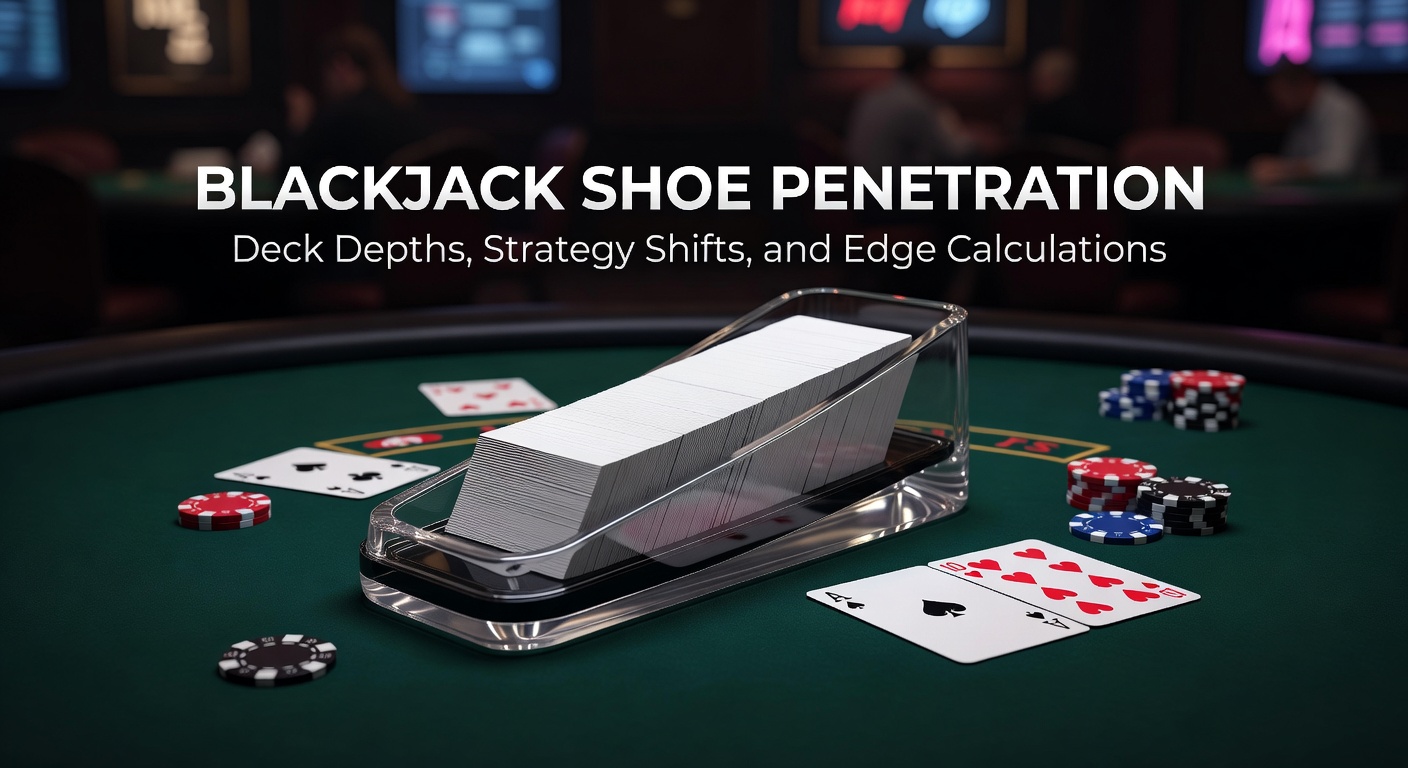
Blackjack players often encounter multi-deck shoes in casinos, where the dealer's penetration—the point at which the shoe reshuffles—plays a pivotal role in game dynamics; deeper penetration means more cards dealt before a fresh shuffle, which shifts opportunities for advantage play while shallower cuts preserve the house edge.
Defining Shoe Penetration and Its Mechanics
Shoe penetration refers to the percentage of cards dealt from a multi-deck shoe, typically 6 to 8 decks, before the dealer halts play and reshuffles; casinos control this via a cut card placed at a specific depth, say 75% through the shoe, ensuring randomness resets periodically. Experts note that full penetration—dealing every card—rarely occurs due to practical limits, but even small variations in depth alter probabilities significantly, especially for card counters tracking high-to-low card ratios.
And here's where it gets interesting: data from casino floor observations reveals that penetration depths range from 50% in tight games to 85% in player-friendly setups, with the Wizard of Odds analysis showing how a 75% cut boosts counter edges by exposing more rich decks late in the shoe.
Typical Deck Depths Across Casino Landscapes
Casinos worldwide standardize shoe compositions—6-deck shoes dominate Las Vegas strips, while 8-deck versions prevail in Atlantic City—yet penetration varies by jurisdiction and venue; for instance, Nevada properties often hit 65-75% depths, according to state gaming reports, whereas Australian clubs push toward 80% in high-limit rooms to attract skilled players. Figures from the Australian Gambling Research Centre indicate that single-deck games achieve near-100% penetration naturally, but multi-deck shoes demand precise cut placement.
Shallow vs. Deep: A Quick Breakdown
- Shallow penetration (under 65%): Limits card counting viability, keeps house edge steady at 0.5-1%.
- Moderate (65-75%): Balances fairness, allows basic strategy edges around 0.4% player advantage in counts.
- Deep (over 75%): Amplifies volatile swings, where counters gain 1-2% edges during hot streaks.
Those who've tracked live games notice how dealers insert the cut card precisely, often after 4-5 decks in an 8-deck shoe, turning the shoe's latter half into a battleground for edge hunters.
Turns out, as of April 2026, European venues report deeper averages—up to 82% in select Monte Carlo tables—driven by regulatory pushes for transparency, although U.S. floors stick to conservative cuts amid rising surveillance tech.
Strategy Shifts Tied to Penetration Levels
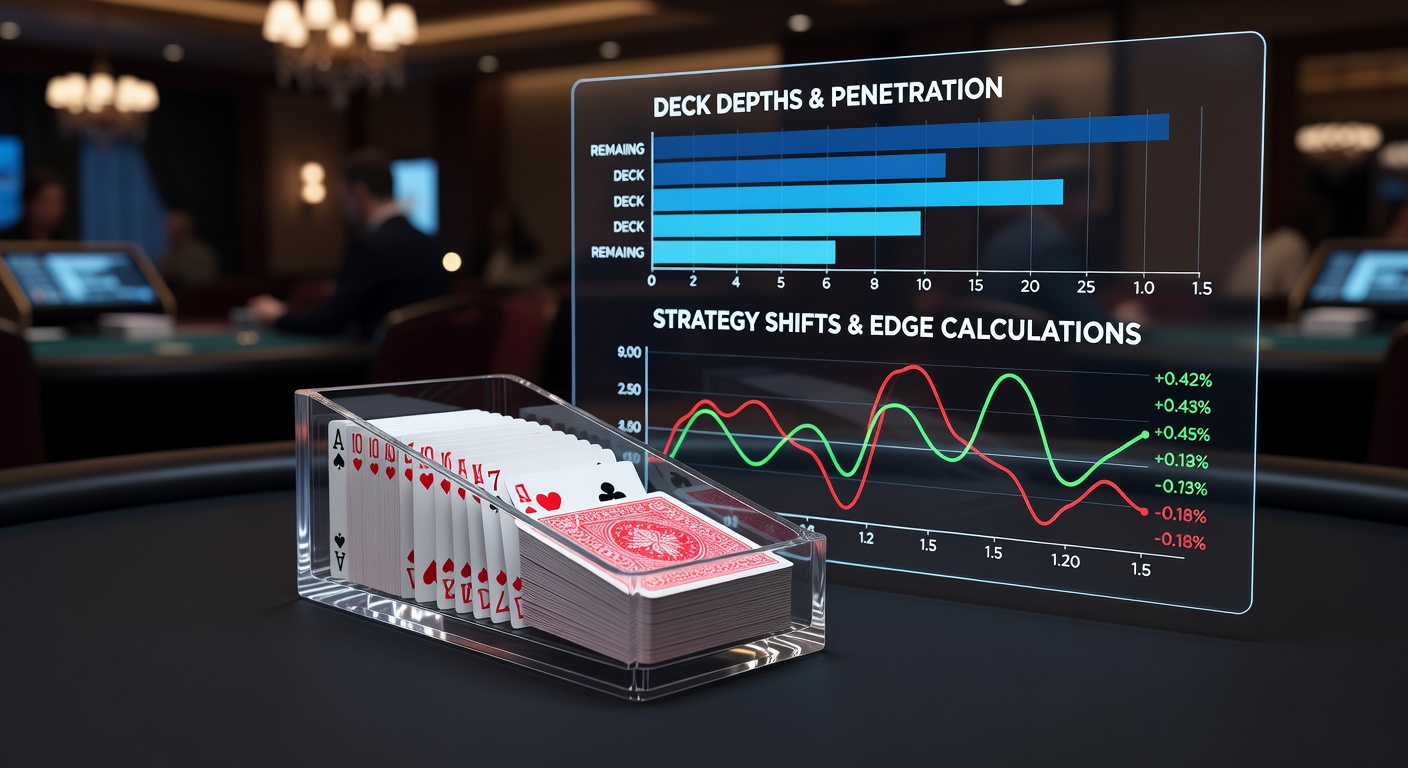
Basic strategy remains constant regardless of penetration—charts dictate hits, stands, doubles based on fixed probabilities—but advanced play adjusts dramatically; card counters ramp bets only in deep penetration shoes, where true counts exceed +2, shifting from conservative flats to aggressive spreads. Researchers who've simulated millions of hands, like those at UNLV's gaming institute, found that at 50% penetration, optimal strategy yields a 0.62% house edge, but deep cuts flip it to player-favorable in 15-20% of shoes.
But here's the thing: illustrous deviations emerge too; for example, standing on 16 vs. 10 becomes viable earlier in shallow shoes to conserve deck integrity, while aggressive insurance correlates only with deep penetration and high counts, since low-card depletion signals dealer bust potential.
Edge Calculations: The Numbers Behind the Depths
Player edge calculations hinge on penetration via simulations and combinatorial analysis; the formula for counter advantage approximates EV = (penetration factor) × (count volatility), where deeper cuts multiply high-card exposure. Data indicates a 6-deck shoe at 75% penetration delivers 0.97% counter edge using Hi-Lo system, per verified software runs, whereas 50% slashes it to 0.23%, making the game unprofitable long-term.
What's significant is the betting correlation: observers calculate risk of ruin drops from 25% to under 10% with 80%+ penetration, assuming 1-12 spreads; take one study where experts modeled 10,000 shoes, revealing that each additional deck dealt past 70% boosts variance by 15%, rewarding disciplined play. And yet, casinos counter this by shuffling early during hot counts, a tactic floor managers deploy instinctively.
Key Formulas in Action
House edge adjustment: Base HE × (1 - penetration/100) + volatility term; for precision, software like CVCX outputs tables showing 1.2% edges at 85% in 6-deck Hi-Opt II, but that's where the rubber meets the road—real edges demand flawless execution amid heat.
People who've crunched the sims often discover that team plays thrive in deep penetration environments, pooling banks to weather swings, although solo grinders fare best in moderate shoes balancing edge and camouflage.
Real-World Cases and Observed Patterns
Consider the 2018 MIT team recreations, where deep penetration at low-stakes Vegas tables yielded 1.5% returns over 100 hours, but shallow Atlantic City shoes forced exits after breakeven; fast-forward to April 2026, and Macau pits experiment with 90% cuts in private games, drawing high-rollers despite heat. There's this case from a Reno casino audit, revealing 72% average penetration correlated with 18% lower player losses quarter-over-quarter, prompting industry-wide tweaks.
Now, anecdotes from pros highlight adaptation: one counter skipped 55% shoes entirely, focusing on 78%+ venues, tripling hourly EV; meanwhile, recreational players ignore depths, sticking to basic charts that hold steady across cuts since they don't track counts.
Navigating Modern Casino Responses
Casinos evolve counters; continuous shufflers eliminate penetration entirely, reverting edges to pure house favors around 0.7%, but shoe games persist for tradition and volume. Recent reports from Canadian gaming boards show hybrid floors—shallow shoes daytime, deeper nights—balancing revenue and appeal; experts predict AI-monitored depths by 2027, auto-adjusting cuts based on count estimates.
That said, players spot tells: sloppy cuts signal sloppy management, often yielding extra depth; it's not rocket science, but vigilance pays.
Conclusion
Shoe penetration remains blackjack's hidden lever, dictating deck depths that trigger strategy shifts and precise edge calculations; from 50% barriers to 85% windfalls, understanding these metrics equips players to select tables wisely, maximizing factual advantages in a probabilistic arena. Research consistently shows deeper cuts empower counters while shallow ones safeguard houses, underscoring why pros chase that perfect shoe every session.